

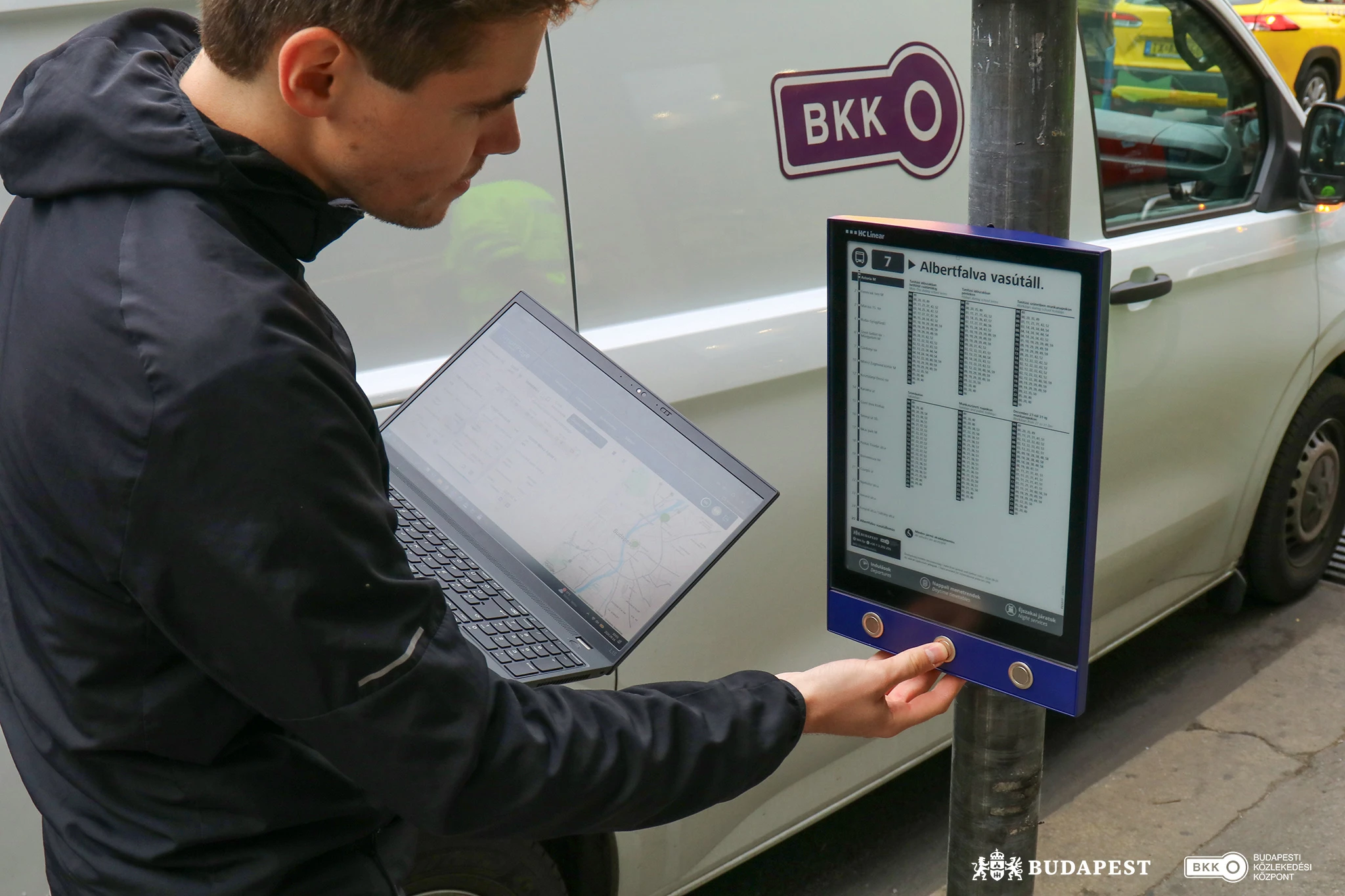
Budapest, 14 September 2026 – Always-up-to-date timetables, real-time departure times, and current traffic information on a single display — BKK’s new digital timetable boards will be installed at 61 stops in Budapest this September. Powered by solar panels or rechargeable batteries, these devices—functioning as a sort of “mini FUTÁR display”— provide passengers with significantly more and more up-to-date information than traditional paper-based timetables. The company will test this modern technology for two years to determine, based on its experience, whether to implement it on a wider scale.
The paper-based timetable, which has been well known for decades, has many drawbacks: it gets torn off, defaced, faded by UV rays and sunlight, covered in stickers, and the plexiglass protecting the pages gets scratched; moreover, it can only hold a limited amount of information. E-paper, however, can leave many of these issues behind. Budapest is now testing how the technology can be integrated into everyday travel.
On 14 September 2026, BKK Centre for Budapest Transport will begin installing the first e-paper-based timetables in the city. These devices are easy for anyone to use, and their operation is straightforward. Passengers will first encounter them along Rákóczi út, at the Zugló train station, at Keleti Railway Station, as well as at Uránia and Astoria stops. Installation will continue through the end of September, and during the two-year trial period, these devices will be operational at a total of 61 stops.
One of the biggest advantages of this development is that information provided at stops can become faster and more flexible. Until now, current schedules and information could only be updated through on-site work, whereas the content of digital displays can be updated centrally online. This means that staff do not need to be sent to a specific stop every time there is a timetable change or new travel information needs to be displayed.
You always know when the bus is coming — and it even talks
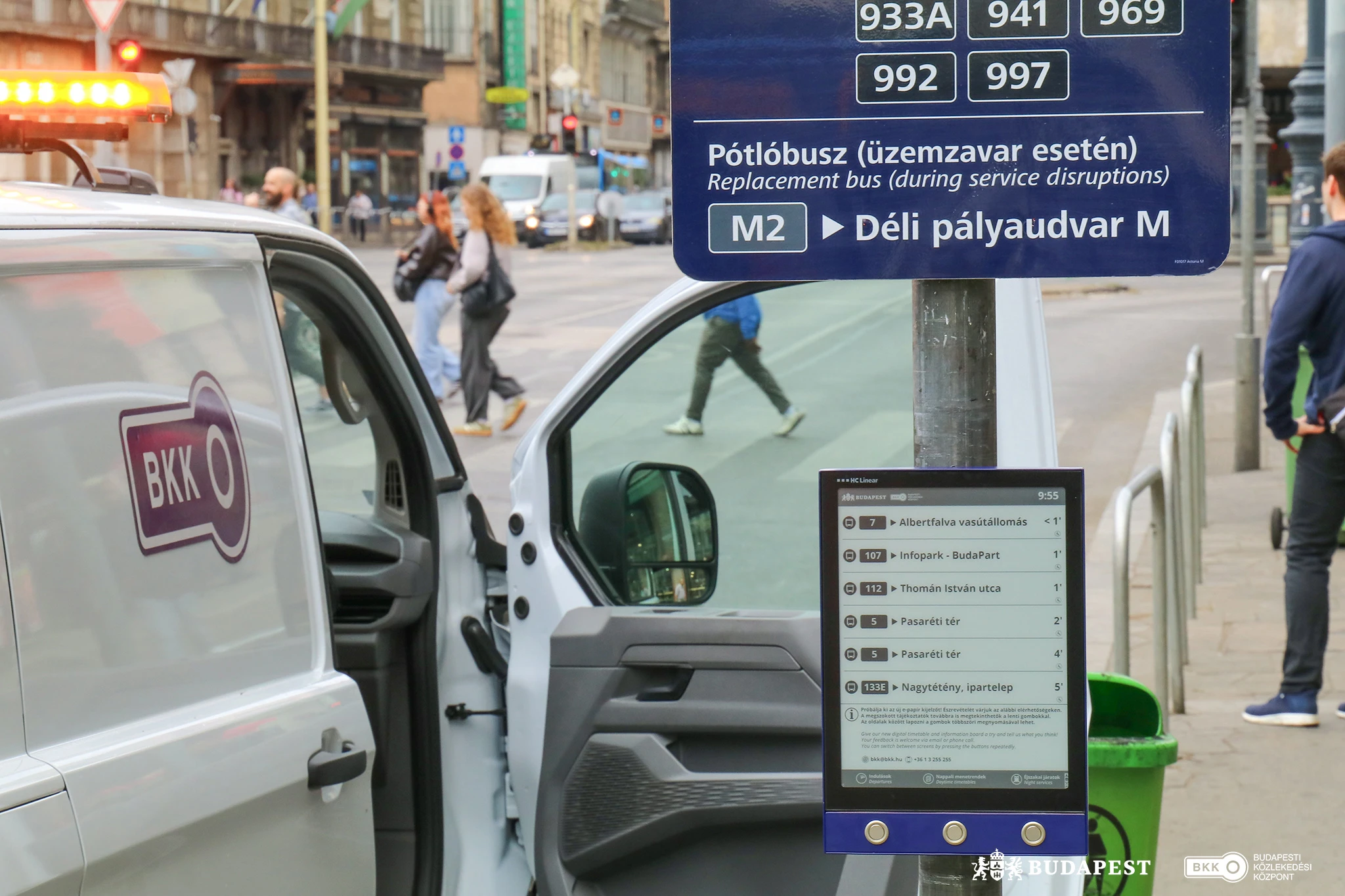
However, e-paper technology is not simply a digital version of the traditional timetable. The devices display real-time departure times for lines serving the stop, as well as current traffic information and service disruptions, so in terms of their function, they also act as a kind of “mini FUTÁR display.”
BKK customers can use the buttons on the display to switch between screens and scroll through the various pieces of information. The information typically found at bus stops will not disappear; the goal is to make it available on a single, unified digital interface instead of the “forest of signs” that sometimes consists of several separate information displays.
A key feature of e-paper technology is its extremely low energy consumption. The black-and-white display offers high contrast and is easy to read, while consuming very little power. The digital schedule boards are powered by solar panels or rechargeable batteries, so there is no need to install an electrical grid for their deployment. This could significantly expand the number of stops where digital, real-time passenger information will be available in the future.
The solution represents a step forward from both an environmental and operational perspective, as it may reduce the need for paper timetable notices, printing, and on-site visits.
An important element of the two-year trial period now beginning is accessible passenger information. When installing the devices, BKK experts ensure that they can be used comfortably by wheelchair users. Visually impaired passengers can use a remote control to have the device read out the departure times of upcoming lines and current traffic information. This makes real-time audio information available even at stops that currently lack an on-street FUTÁR display.
BKK can monitor the digital timetable boards remotely, and the devices are equipped with vandalism and displacement sensors. If a display is moved, the system immediately sends an alert to the control centre.
Two technologies to be tested over two years
BKK is not committing to a single solution; during the two-year pilot programme, it will compare the e-paper technologies of two manufacturers. In addition to displays from the Hungarian company HC Linear, devices from the British firm Papercast will also be installed in the Hungarian capital. Travelers can encounter the latter’s technology in London, Ostrava, and Los Angeles, among other places.
Experts selected the locations so that all 23 districts of Budapest would have a digital timetable and travel information display. There will also be pairs of stops where devices from both manufacturers can be used under similar conditions by essentially the same group of passengers. Over the next two years, BKK will evaluate, among other things, the devices’ readability, reliability, power supply, weather resistance, and ease of use.
Based on the experiences of the next two years, a decision will be made regarding the role e-paper technology will play in Budapest’s future passenger information system. BKK is therefore asking its customers to share their experiences and opinions by emailing to [email protected]
Let’s take good care of the new displays so that we can see them at even more stops in Budapest in the future.